I confess. I am living as an island.
Many of us do it. We go to church with plastic smiles and act like everything is ok. We don’t want to admit that our lives are messy or overwhelming or sinful, so we cut ourselves off and don’t allow anyone to connect with us. What’s more, we don’t make much of an attempt to connect with others either.
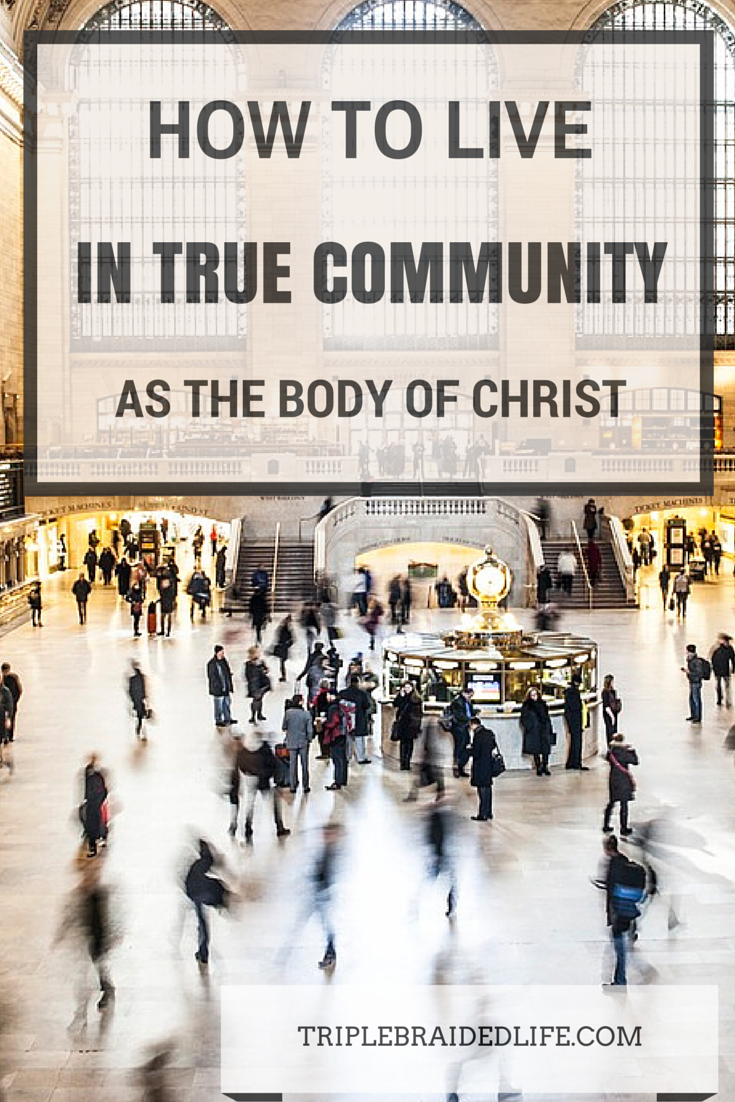
It’s typical now to have shallow relationships. Think about your own relationships. How many Facebook friends do you have? How many people follow you on Twitter and Instagram? Now how many of those people do you really know? When was the last time you had a meal with him? When did you last have a heart to heart talk with her? We live in a culture where relationships are a mile wide and an inch deep.
But this is not how God designed us to be . . . especially Christians. I’m sure you have heard John Donne’s famous line, “no man is an island.” But you may not realize that the entire meditation in which this phrase appears concerns the Church:
No man is an island, entire of itself; every man is a piece of the continent, a part of the main . . . any man’s death diminishes me, because I am involved in mankind” (Devotions upon Emergent Occasions).
Paul describes the Church in a fascinating word picture in 1 Corinthians 12:12, 25: “The body is a unit though it is made up of many parts; and though all its parts are many, they form one body…there should be no division in the body but its parts should have equal concern for each other” (NIV).
This portion of scripture began to come alive to me many years ago when I discovered the writing of Dr. Paul Brand, a missionary doctor who was a pioneer in the treatment and rehabilitation of people with leprosy. Brand’s writing explores the medical science behind the creation of the human body (in itself a compelling shout of praise to the Creator!), but continues by exploring the Body of Christ, the Church.
I love Brand’s viewpoint on how human cells mirror the individuals within the Church:
In Christ’s Body, the Spirit establishes a connection not only between each cell and the Head but also among all the cells of the Body. The very word “church” in Greek means called-out ones and in the church God calls us into an organic community. The Spirit does not approach me in the solitude of my own soul, for that would leave me alone and unreconciled to my neighbor. Rather, the Spirit calls me to join a Body that binds me in love with a community of diverse cells. Each individual cell awakens to the conscious reality of the larger whole. Jesus prayed for an even richer experience of unity in his Body. He asked ‘that all of them may be one, Father, just as you are in me and I am in you. May they also be in us so that the world may believe that you have sent me’ (John 17:21). Do we catch a glimmer of the wonder of that unity in the church, a unity based not on social class or interest group or kinship or race, but on common belonging in Jesus Christ?”(Fearfully and Wonderfully Made)
The need for connection within the Church recently became clearer to me through a selfish desire of mine when I was going through a season of loneliness. Many of my friends had begun to move on to new life experiences and I felt somewhat alone. So I asked God for better friendships, and He gave opportunities for me to be a better friend.
He began leading people who were going through crises to seek me out for counsel and support. With sincere love and concern for these individuals in my life, I am learning to be a better friend and those relationships have deepened.
This and several other recent events reminded me that despite the polished exterior that the Church tries to present, we Christians are downright messy. There’s a lot of pain, confusion, fear, anger and anxiety brewing beneath the plastic smiles you see at each church service. And too often we are numb to the pain. In Fearfully and Wonderfully Made, Brand writes:
Today our world has shrunk, and as a Body we live in awareness of many cells: persecuted Chinese believers, starving Africans, oppressed Indo-Chinese and Central Americans. The litany fills our newspapers. Do we fully attend? Do we hear their cries as unmistakably as our brains hear the complaints of a strained back or broken arm? Or do we instead turn down the volume, filtering our annoying sounds of distress? And closer, within the confines of our own local gathering of Christ’s Body – how do we respond? Tragically, the divorced, the alcoholics, the introverted, the rebellious, the unemployed often report that the church is the last group to show them compassion.”
How tragic that we so often ignore the pain that is right there in our own body. It would be ludicrous for you to break your ankle and just keep on walking like nothing is wrong! So why do we continue act in that very way in the church? As Brand states, “So much of the sorrow in the world is due to the selfishness of one living organism that simply does not care when another suffers. In Christ’s Body we suffer because we do not suffer enough.”
But I can’t ignore the pain. We can’t ignore the pain. So how can you and I make sure that we truly connect with those who are hurting in our midst?
Come back tomorrow as I share some practical ways I’ve learned to be more attentive to the needs in the Body of Christ.
 Becca is a regular contributor of Triple Braided. She is a daughter, sister, aunt and, most importantly, a child of the King. She loves singing, reading, hiking, cooking, serving at her church and hanging out with her sweet nieces. Becca works as a curriculum developer at a credit union in her home state of North Carolina.
This is part 1 of the article “How to Live in True Community as the Body of Christ.” Be sure to read part 2 here.
Leave a Reply