Recently I’ve been friendship dumped.
I don’t know the reason. I don’t know the cause. I don’t know what I did wrong. I don’t know what happened.
All I know is that I had a baby. And things changed.
Some of my closest friends called once, and never called again. Visited once, and never visited again. Didn’t ask how my baby was doing or how I was doing with no sleep, emotions flying high, and still trying to keep up with day-to-day life. They didn’t text. Didn’t like pictures on Facebook. Just didn’t . . . do anything.
One of my pet-peeves is passive-aggressive behavior. The silent treatment doesn’t sit well with me. I don’t understand it. “Just say-it-already” is my motto. But they haven’t said it.
Then again, I haven’t either.
I’ve thought about being blunt and asking, “What’s going on?”, but secretly I think I know the answer, and it’s nothing I can fix. And I’m pretty sure I know the response. “Nothing. What do you mean? I’m busy, too. Just because you have a baby doesn’t mean you’re now special.”
No, but it does mean that for this season, since this tiny new life moved into our home, I need you to be my friend. And maybe just a smidgen more of you than normal.
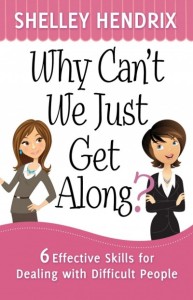
During this time of being friendship dumped, I was given a book called Why Can’t We All Just Get Along?: 6 Effective Skills for Dealing with Difficult People by Shelley Hendrix.
Oh. My. Goodness.
I had never read a Christian book written primarily on female friendships, but, to be honest, I thought it would include the same advice given to me since middle school – don’t gossip, don’t act snooty, treat people nicely.
However, it was nothing like I thought.
Shelley starts the book not by focusing on how to fix all the relationships in our lives, but by turning the issues inward and focusing on ourselves as image bearers of Jesus. She doesn’t use canned answers from pop-psychology, but she takes God’s Word and unfolds it so that we can see how what we believe about God and ourselves affects how we respond or react in relationships.
Shelley says, “When you know who you are, you’ll know what to do. When we don’t know who we are, we spend our time, energy, and resources trying to ‘fix’ the people and circumstances in our lives. We shift blame, we manipulate, we pout, we make concessions. Knowing who we are frees us from this damaging cycle and frees us to be fulfilled and active participants in the Body of Christ.” p. 28
By starting with myself and Jesus, I reflected on my own friendship problems in a new light. Instead of staying in bitterness quicksand, I focused on the one person I can change and the one person I am responsible for fulfilling God’s call – myself.
Shelley goes on in her book to unpack six effective skills to use when dealing with difficult people. Again, each of them were straight from God’s Word.
This is where I gained new perspective.
Yes, I have been very hurt by several friendships recently. I can get really angry about them if I think about them long enough. However, there’s nothing I can do to change another person – to heal her, change her opinion, or make her see circumstances my way.
All I can do is be the friend I want her to be to me.
So that’s what I’ve done. In the past few weeks, I have tried to be more intentional in my friendships to be supportive, encouraging, and prayerful. I’ve tried to ask my friends what they need help with, and I’ve tried to reach out to them more instead of waiting for them to come to me.
To be honest, it hasn’t always been reciprocated, but as Shelley’s book has shown me, I don’t answer to my friends, I answer to God. And He wants to me to live friendships like He would live them.
I am BEYOND THRILLED to be giving away one free copy of Shelley Hendrix’s book What Can’t We All Just Get Along? because I believe in this book so much! EVERY WOMAN NEEDS THIS BOOK! I don’t say that about every book, but I mean those words without any hesitation.
This book is jammed pack of Biblical insights to help us live our friendships the way God intends. There is so much Biblical truth in it, and you can even use it as a personal or group Bible study!
Now share with us, what’s your biggest struggle in female friendships?
